When people talk about “processed food”, they often imagine a single category. In reality, food processing covers a very broad spectrum, from simply washing vegetables to creating products in a laboratory with dozens of ingredients. Understanding this spectrum helps us make more informed choices without oversimplifying the issue.

The most widely used scientific tool for distinguishing levels of processing is the NOVA classification, developed by researchers at the University of São Paulo and now also adopted by several public health agencies. It divides foods into four groups: unprocessed or minimally processed foods (fresh vegetables, fruit, eggs, raw meat and whole grains); processed culinary ingredients (oil, butter, sugar and salt, used in cooking); processed foods (bread, cheese and foods preserved in oil, made by adding salt, sugar or oil to foods from the first group); and ultra-processed foods, the category attracting the most scientific attention.

Ultra-processed foods are not simply “heavily processed”. Their distinguishing feature is that they contain ingredients rarely found in a home kitchen — glucose-fructose syrup, hydrolysed proteins, modified starches, emulsifiers, artificial flavourings and colourings — and result from industrial processes, such as extrusion and hydrogenation, rather than traditional cooking techniques. Packaged snacks, sugary drinks, brightly coloured breakfast cereals, frozen ready meals and many supermarket “light” or “high-protein” products typically fall into this category.

A randomised controlled study published in 2019 by researchers at the National Institutes of Health compared two diets, one based on unprocessed foods and one on ultra-processed foods, designed to provide the same amounts of calories, sugars, fats, fibre and macronutrients. Participants eating the ultra-processed diet spontaneously consumed around 500 kcal more per day and gained weight, whereas they lost weight during the unprocessed-food phase, despite being allowed to eat until satisfied in both conditions. This suggests that the degree of processing can influence eating behaviour independently of macronutrient composition alone, probably because of the higher calorie density, industrially engineered palatability and faster eating rate associated with many ultra-processed foods.
It is important not to demonise every form of food processing. Freezing, pasteurisation, fermentation and drying often preserve or even improve food safety and nutritional value. Vegetables frozen immediately after harvesting may retain more vitamins than fresh vegetables left on shelves for several days. The main concern is specifically industrial ultra-processing, rather than processing in general.

A useful approach does not require eliminating every packaged product. Instead, gradually shift the centre of your diet towards the first and second NOVA groups while reducing the proportion of ultra-processed foods. In practice, prioritise single-ingredient or minimally processed foods — vegetables, fruit, pulses, whole grains, meat, fish, eggs and plain dairy products — and cook most meals at home, reserving products from the fourth group for occasional rather than daily consumption.
Rather than obsessively counting individual nutrients, this perspective often provides a practical, sustainable way to guide everyday food choices towards better overall dietary quality.
Shifting the focus of your diet towards whole and minimally processed foods — vegetables, fruit, pulses, whole grains, meat, fish and eggs — is more than a healthy-eating trend. Scientific research accumulated over the past twenty years provides fairly consistent evidence of the practical benefits of this approach.

Whole foods tend to have a higher nutrient density than their refined or ultra-processed counterparts. For the same number of calories, they generally provide more vitamins, minerals, fibre and bioactive compounds, such as polyphenols and antioxidants. Whole grains retain the bran and germ, where most of the fibre, B vitamins and minerals are concentrated. These are removed during refining to produce white flours that are easier to work with and have a longer shelf life.

The fibre and intact physical structure of whole foods slow digestion and promote a greater sense of fullness for the same number of calories than refined or ultra-processed foods, which tend to be more calorie-dense and quicker to eat. This mechanism, already discussed in relation to experimental studies on ultra-processed foods, also applies to the broader comparison between eating patterns based on whole foods and those based on refined foods. It helps explain why observational research often links diets rich in whole foods with better long-term weight management.

Whole foods typically have a lower glycaemic index than refined versions. Fibre and an intact cellular structure slow sugar absorption, reducing blood glucose spikes after meals. Epidemiological studies associate regular whole-grain consumption with a lower risk of developing type 2 diabetes, an association that remains significant after adjusting for other lifestyle factors.

Soluble fibre in pulses, oats and many vegetables helps reduce LDL cholesterol, while unsaturated fats from whole-food sources such as nuts, seeds and fish, as well as olive oil, are associated with a more favourable cardiovascular profile. Eating patterns built mainly around these food groups — such as the traditional Mediterranean diet, which has been extensively studied — have some of the strongest evidence for reducing cardiovascular risk among the dietary patterns investigated.
Most people significantly underestimate how much added sugar they consume each day. This is not necessarily because they knowingly eat too many sweets, but because added sugars are hidden in a surprising number of products that are not perceived as sweet.

Sugar naturally present in whole fruit or milk comes with fibre, water, protein or other nutrients that influence its absorption and overall effect on blood glucose. Added sugar, by contrast, is introduced during food processing or preparation and does not bring these protective elements with it. Major nutritional guidelines, including those of the World Health Organization, focus specifically on reducing these sugars — ideally to less than 10% of total daily calories, and below 5% for additional benefits — rather than sugar naturally present in whole foods.
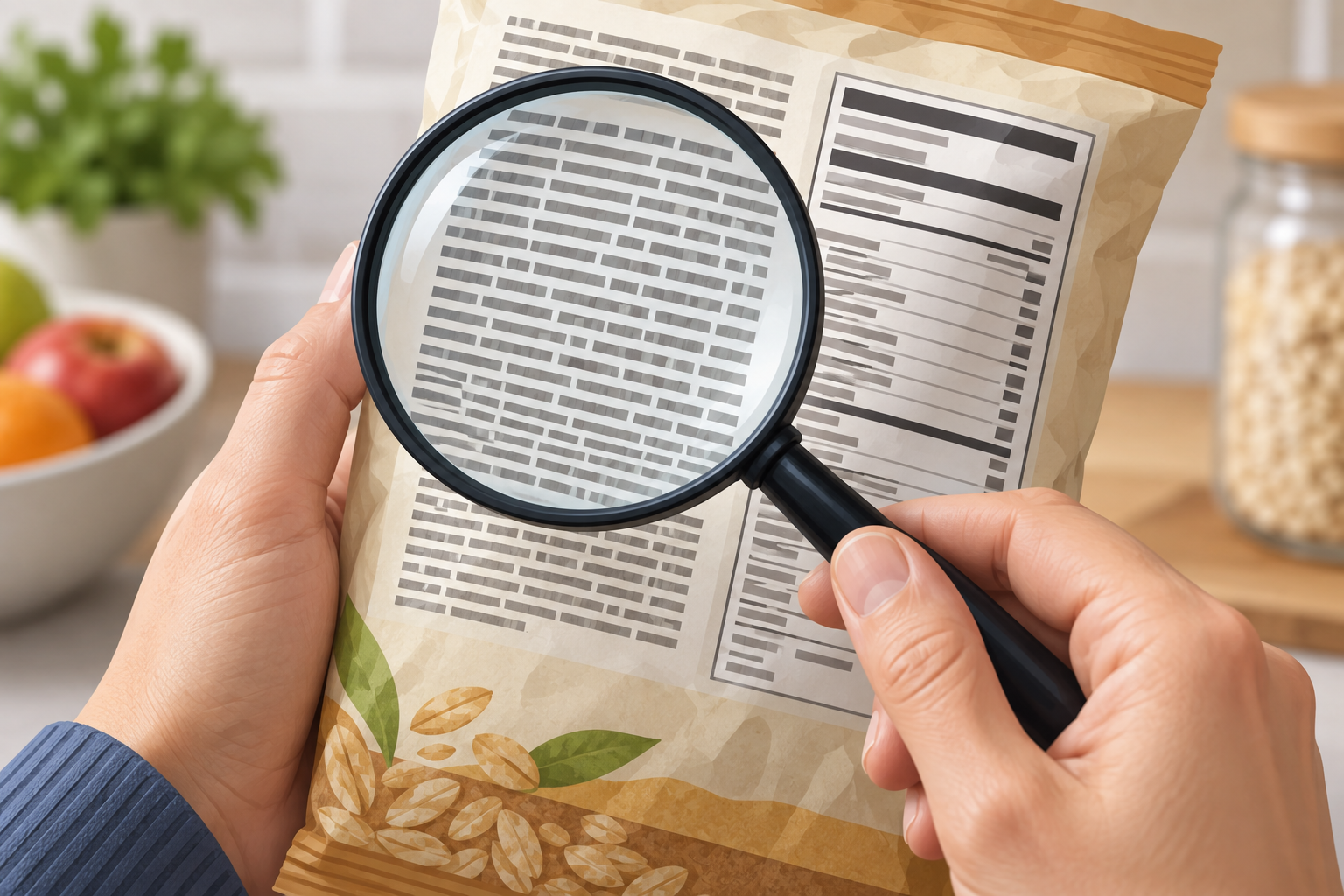
Ready-made pasta sauces, ketchup, salad dressings, packaged bread, sliced processed meats, “fruit” yoghurts and protein bars are among the products most likely to contain significant amounts of added sugar without tasting particularly sweet. A pot of fruit yoghurt can contain as much sugar as a small dessert, while some ready-made pasta sauces contain more sugar per serving than a biscuit.

In many Western populations, sugary drinks — fizzy drinks, packaged fruit juices (including those labelled as having no added sugar but naturally high in concentrated sugars), energy drinks and bottled iced teas — are a major source of dietary sugars. Unlike sugar in solid foods, sugar dissolved in a drink does not generate the same feeling of fullness, making it easier to consume large amounts without noticing the excess.

Even 100% natural fruit juice with no added sugar declared on the label has a very different effect on blood glucose from the whole fruit it comes from. Juicing removes much of the fibre and concentrates sugar into a smaller volume, making it easier to consume the equivalent of several whole fruits within minutes. This does not mean fruit juice is nutritionally identical to a sugary soft drink in terms of micronutrients. However, its effects on blood glucose and calorie intake place it closer to a sugary drink than to a piece of whole fruit.
Refined sugar consumption has risen markedly over the past century alongside the spread of ultra-processed foods, and is now one of the most widely discussed public health issues. Understanding how we reached this point, and what it actually means for health, helps put the subject in perspective without either alarmism or complacency.

Until a little over a century ago, refined sugar was relatively expensive and unavailable to much of the population. Industrial sugar production from cane and beet, together with the development of glucose-fructose syrup from the 1970s onwards, made sugar an inexpensive, ubiquitous ingredient. It is used not only in sweets but also in a vast range of savoury products, from ready-made sauces to packaged bread.

Besides its sweet taste, sugar performs several technological functions in packaged products. It improves shelf life by lowering the water activity available to microorganisms, contributes to texture and browning during cooking, and masks bitter or unpleasant flavours arising from other processing steps. This explains why sugar also appears in products that do not taste noticeably sweet, as discussed in the article on hidden sugars.

Numerous studies associate a chronically high intake of added sugars with an increased risk of obesity, type 2 diabetes and non-alcoholic fatty liver disease. Some more recent analyses also suggest higher cardiovascular risk independently of total calorie intake, although the mechanisms and magnitude of this risk remain active areas of research. Excess fructose, in particular, is metabolised mainly by the liver and, when consumed in consistently large amounts, can promote fat accumulation in the liver.

The World Health Organization recommends limiting free sugars to less than 10% of total daily calories, with additional benefits suggested below 5%, equivalent to around 25 grams a day for an average 2,000 kcal diet. For comparison, a single can of a sugary soft drink may contain 30–35 grams of sugar, exceeding the lower daily target on its own.
Occasional sugar consumption within a diet based mainly on whole foods does not pose a significant health risk for most people. The main concern is the chronically high intake typical of diets built largely around ultra-processed products, in which sugar is pervasive and often goes unnoticed. Gradually reducing hidden sugars, rather than completely eliminating the visible sugar in an occasional dessert, is generally the change with the greatest practical impact on overall health.
Related articles
The E-numbers found on many packaged products often cause concern among consumers, but additives differ in their function, origin and safety profile. Distinguishing between the different categories helps you assess a label more thoughtfully, without assuming that anything with an E-number is dangerous.

Food additives are substances added to food for specific technological purposes: preservation (antioxidants and preservatives), improving texture (thickeners, emulsifiers and stabilisers), or modifying colour or flavour (colourings, flavourings and flavour enhancers). In the European Union, authorised additives undergo a safety assessment by the European Food Safety Authority (EFSA) before they can receive an E-number and be used in food products. Maximum permitted levels are established with broad safety margins relative to doses that show no adverse effects in toxicological studies.

Many widely used additives have a strong, longstanding safety record. Examples include citric acid (E330), naturally present in citrus fruit and used as an acidity regulator; soya or sunflower lecithin (E322), an emulsifier also naturally present in many foods; and ascorbic acid (E300), which is simply synthetic vitamin C used as an antioxidant. Their presence in a product is not, by itself, a sign of poor nutritional quality.

Other additives are the subject of more active research and, sometimes, reviews of their authorisation. Nitrites and nitrates (E249–E252), used to preserve cured and processed meats, have been linked in several studies to the formation of potentially carcinogenic N-nitroso compounds during high-temperature cooking. This is one factor contributing to the classification of processed meat as carcinogenic, discussed elsewhere in this collection. Some azo dyes, such as E102, E110 and E124, have been associated in some studies with a possible increase in hyperactivity in susceptible children, leading the European Union to require a specific warning label for these colourings from 2010.

A relatively recent line of research, mainly in animal models and with some preliminary human studies, has raised questions about the possible effects of certain synthetic emulsifiers, such as carboxymethylcellulose and polysorbates, on the composition of the gut microbiota and inflammation of the intestinal lining. This is still an evolving research area. Findings are not yet definitive or supported by large-scale human studies, but they have contributed to renewed interest in foods with simpler ingredient lists.
You do not need to memorise the safety profile of every additive to make sensible food choices. Consistently prioritising minimally processed foods, which naturally contain few or no additives, automatically reduces overall exposure without requiring an assessment of each individual substance. For packaged products you still choose to buy, a short ingredient list with a limited number of recognisable additives remains a more useful practical guide than a general fear of every E-number.
Related articles
 Avocado